
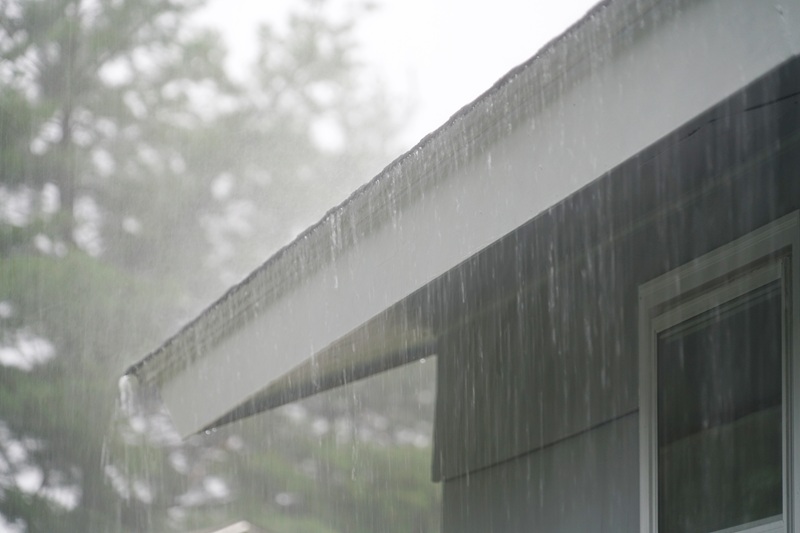
A roof valley forms where two sloping roof surfaces meet, creating a channel that collects and concentrates rainfall from both planes. Because water from a substantial portion of the roof funnels into a single linear path, valleys move a significantly higher volume of water than any other section of the roof. When that water reaches the base of the valley, it carries enough speed and volume to overshoot gutters, erode landscaping, damage siding, and pool against the foundation.
Why You May Want to Divert Water from Roof Valleys
The steeper the roof pitch and the longer the valley, the greater the water volume and velocity at the base. Even moderate rainfall can generate enough flow through a long valley to overwhelm a standard gutter. When that happens, water misses the gutter entirely and falls directly against the home, which can saturate the soil at the foundation, cause basement moisture intrusion, erode mulch and landscaping beds, and create slip hazards on walkways below. In colder climates, unmanaged valley runoff can also contribute to ice dam formation at the eaves. Homeowners with valleys that terminate above a doorway, window, or frequently used walkway have a particularly urgent reason to address water diversion before structural or cosmetic damage accumulates.
Valley performance is also affected by debris accumulation. Leaves, twigs, and pine needles tend to collect in the channel because gravity pulls everything downhill along the same path as the water. When debris builds up at the base of a valley, it can partially block the gutter inlet, forcing water to back up and spill over the edge or seep beneath the roofing material.
See why homeowners trust DaBella with their roof replacement
Methods for Diverting Water from Roof Valleys
Here are some ways that roofers like DaBella channel water away from roof valleys:
Installation of Roof Valley Diverters
A roof valley rain diverter is an aluminum component installed at the lower terminus of the valley, positioned above the gutter. It functions like a wide-mouthed funnel, catching water before it reaches the gutter edge and redistributing it across a broader section of the gutter rather than concentrating it at a single point. Many diverters include a fine mesh screen on top to prevent debris from collecting inside the unit and creating a blockage. Because the diverter spreads the load over a larger area, it reduces the risk of overflow even during heavy rainfall events. Diverters are available in standard aluminum finishes and can be painted to blend with the gutter system. They are best installed by a roofing professional who can assess the valley geometry and position the unit correctly for maximum effectiveness.
Using Splash Guards Effectively
A splash guard is an L-shaped aluminum bracket mounted on the outer lip of the gutter at the base of the valley. Its purpose is to act as a barrier that prevents fast-moving water from overshooting the gutter. Splash guards are a simpler and less expensive option than valley diverters, and they can be effective during light to moderate rainfall. However, because of their flat barrier design, they are less efficient than funnel-style diverters in heavy rain, as a strong flow can still carry water up and over the guard. Splash guards also create a collection point for debris, which can build up against the barrier and eventually block the gutter entrance. If gutter guards are installed on the home, splash guards lose much of their effectiveness because water can no longer enter the gutter as freely as it could when the gutter was open. For homes with covered gutters, a roof-mounted valley diverter is generally the more reliable solution.
Creating Channels or Troughs for Better Runoff
In situations where standard diverters are not sufficient, it is possible to extend water management further by routing runoff away from the structure through landscaping solutions. A strategically placed rain barrel positioned beneath the valley can capture overflow water and redirect it through an attached hose to a location away from the foundation. French drains installed below the drip line can intercept water that reaches the ground and carry it away from the home. Regrading the soil near the foundation to slope away from the structure at a minimum of six inches over ten feet, as recommended by most building codes, prevents pooled water from migrating toward the basement. River rock or gravel placed directly below the valley outlet can absorb the impact of falling water and reduce erosion and splash damage to the siding.
Maintenance and Prevention Tips
Roof valleys require more frequent attention than any other part of the roof because they accumulate both water and debris at a higher rate. Inspecting and clearing valleys at least twice per year, typically in late fall after leaf drop and again in early spring, prevents debris from building up to the point where it backs up water beneath the roofing material. During inspections, check the valley flashing for cracking, lifting, or corrosion. Metal valley flashing that has lost its seal along the edges allows water to infiltrate the roof deck, which can lead to rot and interior leaks that are not immediately visible.
Gutter alignment is critical to valley performance. The gutter below a valley should slope toward the nearest downspout at the accepted minimum pitch of approximately one-quarter inch of drop per ten feet of run. Gutters that have pulled away from the fascia, sagged, or shifted out of alignment hold standing water and reduce the capacity available to absorb valley runoff. Downspouts should never be located directly at the inside corner where two gutter runs meet beneath a valley. When a downspout is placed at that junction, water arrives from three directions simultaneously, including the valley above and both adjacent gutter runs, which concentrates the maximum possible volume at the one point least equipped to handle it. Positioning downspouts toward the ends of straight gutter runs allows water to move progressively and exit in an orderly fashion.
Common drainage problems to watch for include water staining on the fascia board or siding directly below the valley, erosion channels in landscaping beds that align with the valley terminus, pooling water near the foundation after rain events, and granule loss on the shingles within the valley channel, which indicates surface erosion from high-velocity water flow. Any of these signs warrants an inspection of both the valley and the gutter system below it.
See why homeowners trust DaBella with their roof replacement
FAQs: Diverting Water from Roof Valleys
Questions from homeowners we frequently receive from homeowners about the diversion of water on roof valleys:
How effective are leak diverters?
Roof valley diverters are effective at reducing overflow and spreading water load across the gutter when properly sized and installed. Their effectiveness depends on the length and pitch of the valley, the volume of rainfall, and whether the gutter system beneath them is correctly sized and clear of debris. They are not a universal fix for an undersized or damaged gutter system, but they are one of the most targeted solutions available for the specific problem of concentrated valley runoff.
How do you slow down water in a roof valley?
The most practical ways to reduce water velocity in a valley are to install a diverter that spreads the flow before it exits the roof, ensure the gutter below is clean and properly pitched, and address any debris accumulation in the valley channel that might create turbulence or blockages. Altering the roof pitch itself is not a practical solution for existing structures, so managing the water at the transition point between the roof and the gutter is where intervention is most effective.
Do rain diverters cause problems?
Rain diverters can create issues if improperly installed or if debris can accumulate against them. A poorly positioned diverter can redirect water to an unintended location on the roof or cause it to run behind the gutter rather than into it. Diverters with mesh screens help prevent debris buildup, but they still require periodic inspection to confirm the screen remains clear. When installed correctly on an adequately sized gutter system, diverters generally perform well without introducing new problems.
What are some common problems with leak diverters?
The most frequently reported issues with roof valley diverters include debris accumulation against the unit, improper placement that sends water behind the gutter, and corrosion over time if a low-grade aluminum or non-weather-resistant material was used. In areas with heavy snowfall, snow and ice can load against a diverter and lift or dislodge it if it is not securely fastened. Selecting a high-grade aluminum diverter and having it installed by an experienced roofer who understands the specific geometry of the valley will minimize most of these concerns.
Contact DaBella Today If Your Home Needs a Roof Replacement
If your roof drainage problems stem from aging materials or improper installation rather than a simple hardware fix, a full roof replacement may be the right solution. DaBella is a GAF Master Elite roofer, a designation held by fewer than two percent of roofing contractors in the United States, which qualifies DaBella to offer GAF’s strongest warranty coverage.
DaBella installs GAF HDZ asphalt shingles, which feature Tru-Bond sealant technology and a layered design engineered for strong wind resistance and long-term durability. A wide range of styles is available to complement any home architecture. Every installation is completed by experienced crews trained to optimize water diversion from day one, including proper valley flashing, gutter alignment, and drainage planning. To schedule a consultation, contact DaBella today at 844-DaBella.
Continue reading